


SEO The Business Optimizer
Search Engine Optimization (SEO) refers to the method used to increase a website ranking on search engine results pages...
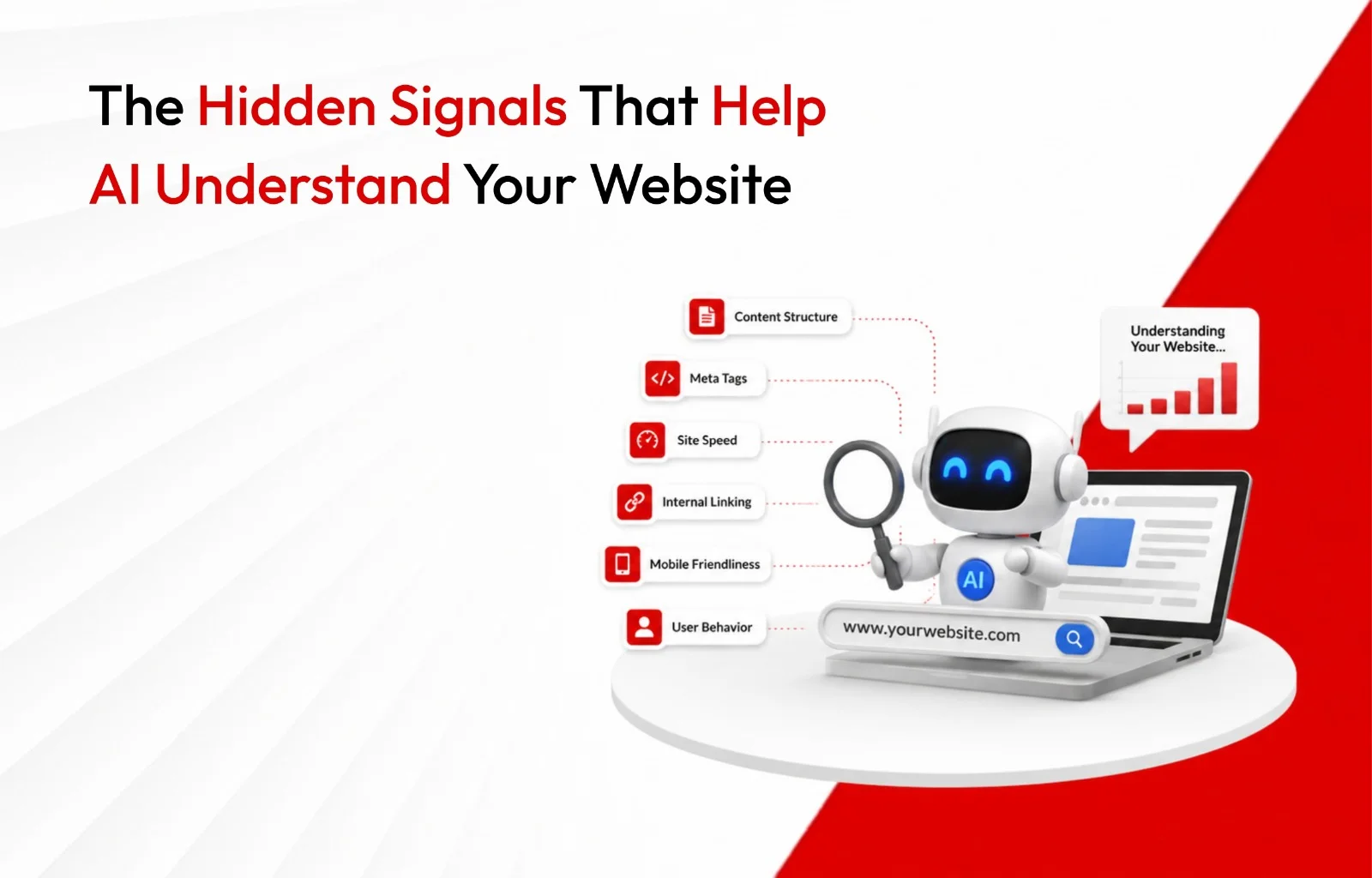
Your website may look perfect to a human. But can AI actually understand it?
In the age of AI-powered search, simply having a beautiful website and adding the right keywords is no longer enough. Search engines and AI platforms such as Google’s AI Overviews and ChatGPT are becoming better at understanding context, meaning, relationships, and credibility.
That means your website needs to communicate more than just words. It needs to send the right signals.
These signals may not always be visible to your visitors, but they help AI understand who you are, what you offer, what your content means, and whether your website is a reliable source of information.
So, what are these hidden signals, and how can you make your website easier for AI to understand?
Keywords still matter for SEO, but repeating a keyword across a page won't automatically make your website relevant.
AI-powered search looks at the broader context around a topic. For example, a website targeting digital marketing services can build stronger topical relevance by naturally discussing SEO, content marketing, social media marketing, paid advertising, analytics, and conversion optimisation.
This is where topical authority comes in. Instead of creating separate articles just to target individual keywords, build a connected content ecosystem around your core topics. When your pages consistently cover related subjects in depth, AI gets more context about your expertise.
Humans can often understand what a webpage element represents simply by looking at it. AI and search engines need more explicit information.
This is where structured data helps. Structured data is machine-readable information added to your website that helps search engines identify different types of content. It can provide context about your organisation, products, services, articles, events, FAQs, locations, and authors.
Using recognised structured data formats such as Schema.org can make the information on your website easier for search engines to interpret.
Think of structured data as giving AI a labelled map instead of making it guess the route.
AI doesn't just understand individual keywords. It also tries to identify entities such as brands, businesses, people, products, locations, and concepts.
For example, your website shouldn't simply say that you offer “marketing services.” It should clearly communicate your brand identity, services, expertise, industry, locations, and the problems you solve.
The more clearly these relationships are established, the easier it becomes for AI to understand what your business represents.
The goal isn't keyword stuffing. The goal is recognition.
Imagine your website as a city. Every page is a destination, and internal links are the roads connecting them.
When relevant pages link to each other, they help users and search engines understand how your content is connected.
For example, a blog about AI-ready websites could link to related pages about technical SEO, structured data, content optimisation, and website performance.
This creates a clear content structure and helps search engines discover important pages while understanding relationships between topics.
So, don't think of internal links as just navigation. They're connections that give your website context.
Would you trust an article simply because it mentions your search term 20 times?
Probably not.
AI-powered search is increasingly focused on whether content actually answers a user's question. Your content should provide useful information, address search intent, explain concepts clearly, and naturally cover relevant subtopics.
For example, a page about SEO for websites becomes more useful when it discusses crawling, indexing, page experience, internal linking, structured data, content quality, and search visibility.
The rule is simple:
Write for people first. Optimise for search second.
The internet is overflowing with content, including content generated with AI. This makes credibility increasingly important.
AI systems need signals that help them understand whether information comes from a trustworthy and knowledgeable source.
Your website can strengthen these signals through author information, professional credentials, original research, reliable references, expert contributions, and clear company information.
Don't just tell your audience what you know; in fact, show them why they should trust you.
Would you trust a webpage claiming to share the “latest SEO trends” if it hasn't been updated in five years?
Probably not.
Freshness matters, especially for industries that change quickly. Regularly reviewing important website pages and updating outdated statistics, information, examples, links, and claims can help keep your content accurate and relevant.
Your website shouldn't just say: “We know this.”
It should show: “We keep up with this.”
Your Brand's Digital Identity Goes Beyond Your Website. Your website isn't the only place where AI can encounter information about your business.
Your brand may also appear on business directories, social media profiles, review platforms, industry websites, publications, and other online sources.
If your business name, description, services, location, and other important details are consistent across these platforms, it becomes easier to connect those mentions with the same organisation.
Think of it as creating a consistent digital fingerprint for your brand. The clearer your online identity, the easier it becomes for AI to understand who you are.
AI-friendly content means little if search engines cannot properly access your website.
Your technical SEO creates the foundation for discoverability and understanding. Make sure your website pays attention to essential elements such as:
These may not be the most visible parts of your website, but they help search engines discover, access, and interpret your content.
AI is changing the way people discover information online. Search is no longer just about matching keywords; it’s about understanding questions, context, intent, and the relationships between different ideas. And that means your website needs to communicate clearly; not just to your audience, but to the AI systems helping them find answers.
So, instead of only asking, “Is my website optimised for Google?”, start asking, “Can AI understand who we are, what we do, and why our content matters?”
Because in an AI-first search landscape, being visible isn't simply about using the right keywords. It’s about giving AI enough clear, meaningful signals to understand your website and recognise its relevance.
Your website already has a story to tell. Make sure AI understands it.
 Contact Us


