


SEO The Business Optimizer
Search Engine Optimization (SEO) refers to the method used to increase a website ranking on search engine results pages...
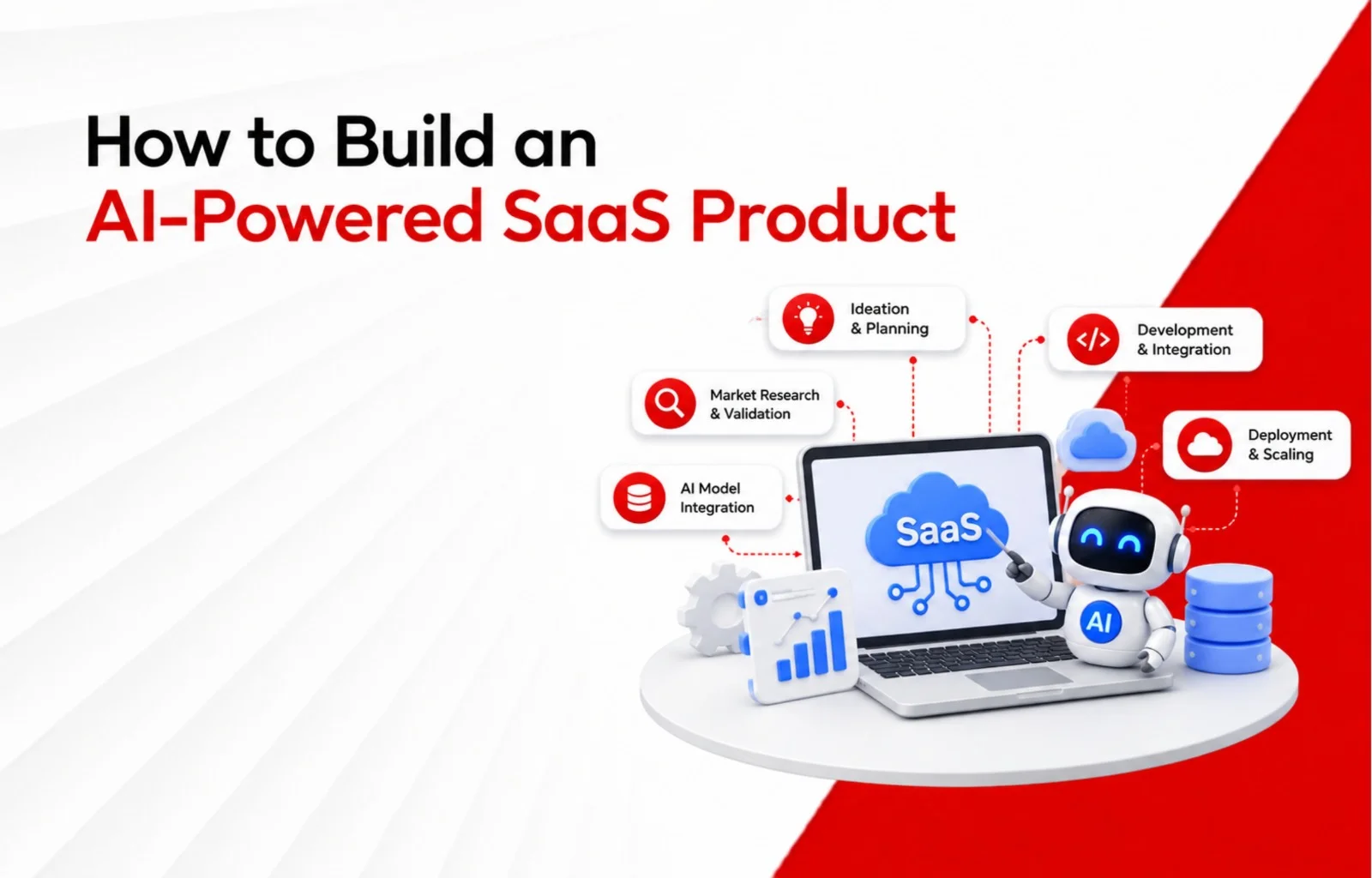
Imagine opening a SaaS product and discovering that it already knows what you need.
It spots patterns before you do. It turns messy data into useful answers. It automates the boring parts of your workflow and gets better at helping you over time. You are not clicking through ten menus to find a report or spending an afternoon sorting through information. The product simply understands the problem and helps you solve it.
That is the appeal of an AI-powered SaaS product.
But there is a catch. Adding AI to a SaaS platform does not automatically make it an AI product. A chatbot bolted onto an existing dashboard is still just a chatbot. A predictive model that nobody uses is simply an expensive experiment.
The real opportunity lies in building software where AI is connected to a genuine customer problem, useful data, intuitive workflows, and measurable outcomes.
So, how do you turn an idea into an AI-powered SaaS product that customers will actually pay for and continue using?
The easiest way to build the wrong AI product is to start with the technology.
“Let’s use generative AI.”
“Let’s add machine learning.”
“Let’s build an AI assistant.”
These sound exciting, but none of them answer the most important question: What problem are we solving?
Start with the customer instead.
Look for tasks that are repetitive, time-consuming, expensive, difficult to scale, or dependent on large amounts of data. These are often fertile ground for AI.
For example, a sales platform could use AI to identify promising leads instead of simply storing customer information. An HR platform could analyse employee feedback and identify recurring workplace concerns. An accounting SaaS product could flag unusual transactions before they become bigger problems.
The difference is subtle but important.
You are not selling “AI.”
You are selling faster decisions, fewer repetitive tasks, better predictions, lower costs, or improved productivity.
Before writing a single line of code, define the problem, identify the target user, understand their current workflow, and determine what success looks like.
If AI disappeared tomorrow, would the problem still matter?
If the answer is yes, you may have the foundation for a strong SaaS product.
Once the problem is clear, the next question is: Where should AI actually enter the experience?
AI can play very different roles inside a SaaS product.
It can predict what might happen next, recommend what a user should do, generate content, classify information, extract insights from unstructured data, or automate repetitive decisions.
Choosing the right AI capability depends entirely on the problem.
Suppose you are building a customer support platform. Instead of simply adding an AI chatbot, you could use AI to classify incoming tickets, detect customer sentiment, suggest responses, identify urgent complaints, and automatically route conversations to the right team.
Now AI is not a decorative feature. It is part of the product's core workflow.
The architecture behind it may combine several technologies, including large language models, machine learning models, APIs, databases, retrieval systems, and traditional software logic.
For generative AI applications, for example, a product might combine a language model with retrieval-augmented generation (RAG) so that responses are grounded in the company's own documents and knowledge base.
The goal is not to use the most sophisticated model available but to use the simplest technology that solves the problem reliably.
AI is only as useful as the information powering it. This is where many ambitious SaaS ideas become complicated.
Your product may need structured customer records, documents, transaction histories, behavioural data, conversations, images, or other sources of information. That data needs to be collected, cleaned, stored, secured, and made accessible to the AI system.
Think of it as building the product's nervous system.
A typical AI-powered SaaS architecture may include:
Data quality matters enormously.
If your product learns from outdated, inconsistent, or incorrect information, the AI can produce equally unreliable results. This is especially important when AI is making recommendations or generating business-critical outputs.
You also need to think about privacy and security from day one. Access controls, encryption, data retention policies, authentication, and responsible handling of customer information should be built into the architecture rather than added as an afterthought.
Because when customers trust your SaaS product with their data, security becomes part of the product experience.
A prototype proves that something can work. A SaaS product has to prove that it works consistently. This is where testing becomes critical.
AI systems can behave differently depending on the data, prompt, context, and model being used. A response that looks impressive during a demo may fail when hundreds of real users begin interacting with the system.
Test your AI against real-world scenarios by measuring accuracy, evaluating response quality, identifying hallucinations, testing edge cases, monitoring latency, and tracking how frequently users accept, reject, edit, or ignore AI-generated outputs.
And remember one important principle: AI should not always make the final decision. For many business applications, a human-in-the-loop approach is more appropriate. Let the AI recommend an action while allowing the user to review and approve it. This is particularly valuable when the consequences of an incorrect output are significant.
You should also design for failure. What happens when the AI does not know the answer? What happens when the model is unavailable? Can users correct the system? Can they report inaccurate responses? These questions are essential when building an AI-powered SaaS product that people can rely on. A trustworthy AI product does not pretend it is perfect. It makes its limitations manageable.
Here is where SaaS becomes different from a traditional software project.
The launch is not the finish line. It is the beginning of the learning loop.
Start with a focused minimum viable product. Give users one strong reason to return rather than ten mediocre features to explore.
Then watch what happens.
Which features do users actually use? Where do they abandon the workflow? Which AI recommendations do they accept? What do they repeatedly correct? What tasks still require manual effort?
These signals can become your product roadmap.
You can gradually improve prompts, models, workflows, data pipelines, and user interfaces based on real usage rather than assumptions.
Pricing also deserves attention at this stage. AI can introduce variable infrastructure costs, especially when your product relies heavily on model inference. Your pricing strategy needs to account for usage, customer value, infrastructure expenses, and scalability.
And never forget the SaaS fundamentals.
Users still expect a fast interface, intuitive navigation, dependable performance, strong customer support, and clear value.
AI may be the engine, but the entire product is the vehicle.
Building an AI-powered SaaS product is not about simply adding an AI model to a futuristic-looking interface.
It is about solving a real problem in a way that makes the user's work easier. That means bringing together the right data, the right AI capabilities, thoughtful product design, reliable technology, and a system that can keep learning and improving over time.
The companies that get this right will not necessarily be the ones with the biggest AI models or the longest list of AI features.
They will be the ones that understand what their customers actually need and use AI where it can make a meaningful difference.
The real goal is to create a product that becomes so useful that customers think, “I don't know how it works. I just know I don't want to work without it.”
That is the real benchmark for an AI-powered SaaS product.
When AI is doing its job well, it should not feel like a technology demonstration. It should feel simple, natural, and almost effortless.
The best AI-powered SaaS does not make work feel more futuristic. It makes work feel easier.
 Contact Us


