


SEO The Business Optimizer
Search Engine Optimization (SEO) refers to the method used to increase a website ranking on search engine results pages...
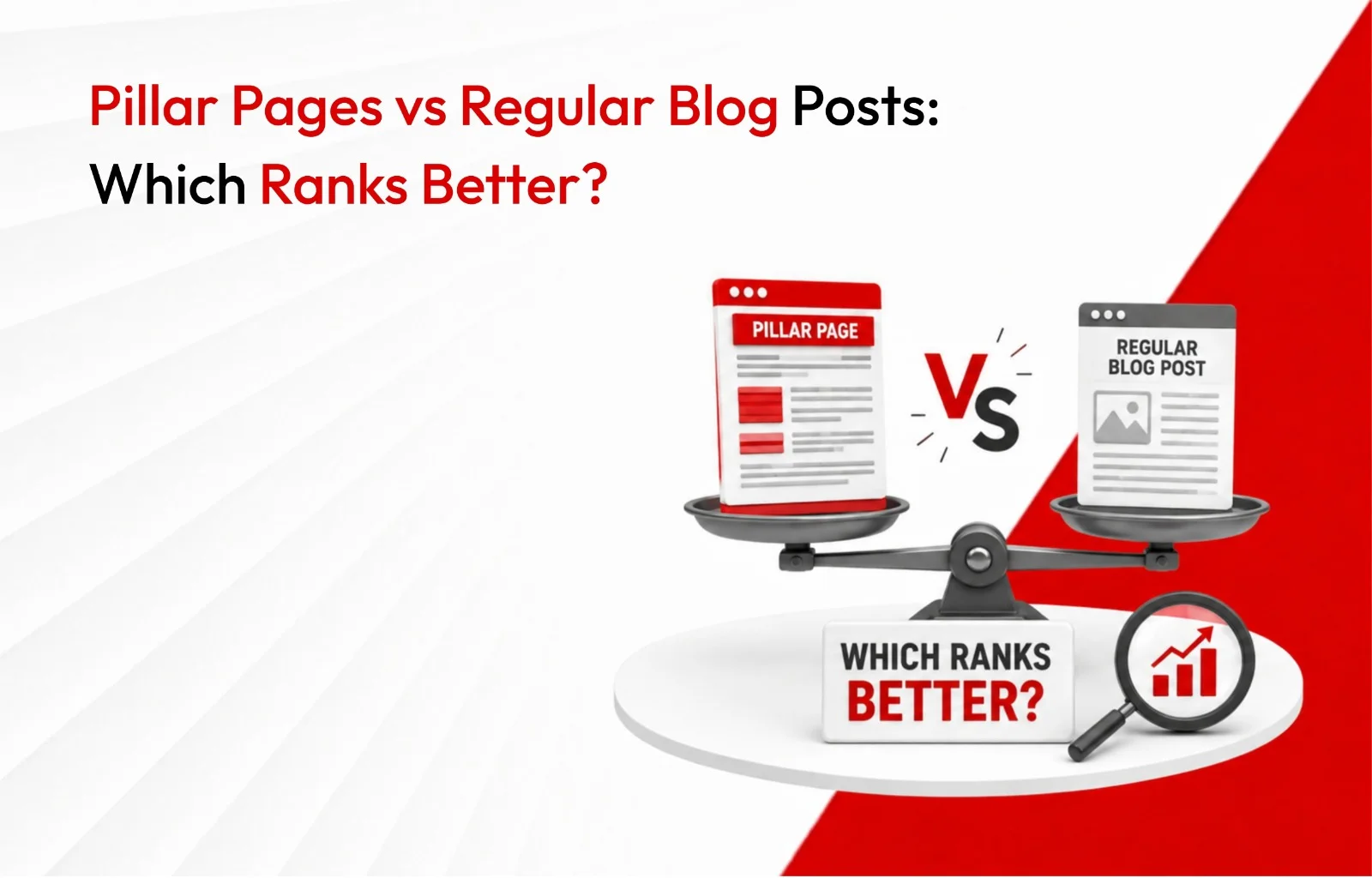
What if the secret to better Google rankings isn’t just writing more blogs, but building the right content structure?
You publish blog after blog. You research keywords, optimise headings, add internal links, and hit “Publish” with high hopes. Yet, your competitors still seem to outrank you.
The problem may not be your writing. It could be how your content is organised.
This is where pillar pages and regular blog posts come into the picture. While both play an important role in SEO, they serve different purposes. A regular blog post usually answers a specific question or explores a focused topic, while a pillar page provides a comprehensive resource around a broader subject and connects to supporting content.
So, which one ranks better?
The short answer: Neither automatically wins. A well-optimised regular blog can rank higher than a weak pillar page, while a strong pillar page can become the central authority for an entire topic.
Let’s break down the difference and understand when each content type works best.
Imagine your website as a city.
A pillar page is the main highway, while your regular blog posts are the smaller roads leading to different destinations.
A pillar page covers a broad topic in considerable depth. For example, if you run a digital marketing website, a pillar page could be:-
“The Complete Guide to Digital Marketing”
It might cover SEO, social media marketing, content marketing, paid advertising, email marketing, analytics, and more. Each major section can then link to detailed blog posts covering specific subtopics.
For example:
This creates a topic cluster, where the pillar page acts as the central hub and supporting blogs provide deeper information.
The biggest advantage? It helps search engines understand that your website has substantial knowledge around a particular subject.
A strong pillar page should therefore be comprehensive, useful, well-structured, easy to navigate, and supported by relevant internal links.
If pillar pages are highways, regular blog posts are the roads that take users exactly where they want to go.
A regular blog generally focuses on one specific search intent or question.
For example:
Instead of covering everything about SEO, each article solves a particular problem.
And that’s exactly why regular blog posts remain powerful.
They allow brands to target long-tail keywords, specific questions, emerging topics, and niche search queries. They can also attract users at different stages of the buying journey.
Someone searching “what is SEO” may be at the awareness stage, while someone searching “best SEO agency for SaaS companies” may be much closer to making a decision.
Regular blogs give you the flexibility to target both.
So, don’t think of regular blogs as the “less important” version of a pillar page. Think of them as the support system that keeps your content ecosystem growing.
Here’s the interesting part: Google doesn’t have a rule saying pillar pages rank better than regular blog posts.
Search engines primarily care about factors such as relevance, content quality, search intent, helpfulness, authority, user experience, and how well a page answers the searcher’s query.
That means a 1,500-word blog answering a very specific question perfectly could outrank a 5,000-word pillar page that tries to cover too much without providing real value.
However, pillar pages can have an advantage when you’re targeting broad, competitive topics.
Why?
Because they can:
Regular blog posts, meanwhile, can be particularly effective for specific and long-tail searches where users want a focused answer.
So, instead of asking, “Which one ranks better?” ask:
“Which content format best matches the search intent?”
That’s the question that can change your SEO strategy.
The smartest SEO strategy isn’t about choosing between pillar pages and regular blog posts. It’s about making them work together.
Think of your pillar page as the trunk of a tree, while regular blog posts are the branches that add depth and reach. The pillar page covers the bigger topic, while supporting blogs dive deeper into specific questions and subtopics.
For example, a pillar page titled “Complete Guide to Content Marketing” could connect to detailed blogs about content calendars, content marketing KPIs, AI in content marketing, content strategy, and common content marketing mistakes.
These supporting blogs can link back to the pillar page, creating a connected network of relevant information. This makes it easier for readers to explore related topics without getting lost.
More importantly, a well-planned internal linking structure can help search engines understand how different pages on your website are connected. Over time, this can strengthen your website’s topical coverage and authority.
The goal isn’t to create as many links or pages as possible. It’s to create meaningful connections between useful pieces of content.
When it comes to pillar pages vs regular blog posts, there’s no magic format that automatically guarantees higher rankings.
A pillar page can perform well for broad and competitive topics because it offers comprehensive information and can connect several related pieces of content. But that doesn’t mean every pillar page will outrank a regular blog.
A focused blog post can actually perform better when it answers a specific search query clearly and completely. If someone searches for “How long does SEO take?”, they probably don’t need a 5,000-word guide covering every aspect of digital marketing.
They want a clear, useful answer.
That’s why search intent matters more than word count. Instead of making content longer simply to make it “SEO-friendly,” focus on making it genuinely useful.
Use pillar pages to establish authority around broad subjects and regular blog posts to target specific questions, long-tail keywords, and niche topics. When both are created with purpose, they can complement each other and create a stronger SEO strategy.
SEO isn’t about publishing content and waiting for Google to reward you. It’s about creating a content structure that makes sense for both search engines and real people.
Pillar pages provide the foundation. Regular blog posts add depth, answer specific questions, and help you reach users searching for more focused information.
When these pages are strategically connected, your website becomes more than a collection of unrelated articles. It becomes a well-connected content ecosystem that demonstrates knowledge across an entire topic.
So, which ranks better: pillar pages or regular blog posts?
The real winner is nothing but your strategy.
Build the pillar. Create valuable supporting content. Connect the dots. Most importantly, focus on answering what your audience is actually searching for.
Because in SEO, smarter content beats simply more content.
 Contact Us


