


SEO The Business Optimizer
Search Engine Optimization (SEO) refers to the method used to increase a website ranking on search engine results pages...
"Google it."
That phrase ruled the internet for years. Whether you wanted to find a nearby cafe, compare smartphones, or research the best marketing agency, Google was the first stop. But fast forward to today, and the way people search has changed dramatically.
Now, instead of typing a few keywords into a search engine, users are asking full-fledged questions to AI tools. They expect instant, conversational answers rather than scrolling through multiple websites. Google itself has joined the AI race with AI Overviews that summarize information before users even click on a webpage.
This shift has rewritten the rules of digital visibility. Ranking on Google is still important, but it's no longer enough. If your business only focuses on Search Engine Optimization (SEO), you could be missing customers who rely on AI-generated answers instead of traditional search results.
Welcome to the new search era, where SEO, AEO, and GEO work together to help your business stay visible whether someone is searching, asking, or simply chatting with AI.
Think about your own online habits. A few years ago, finding information was simple: type a keyword into Google, click a website, and read through the content. Today, that journey looks very different.
A customer might first search on Google, read an AI Overview, ask ChatGPT for recommendations, compare options using an AI tool, and only then visit a business website. In many cases, they make decisions without clicking on more than one or two links or sometimes without clicking on any links at all.
This means your content has to do much more than rank on a search engine. It must answer questions clearly, establish authority, and be structured in a way that AI systems can understand and trust.
That's exactly where SEO, AEO, and GEO come into play.
Search Engine Optimization, commonly known as SEO, has been the backbone of digital marketing for decades. Its primary purpose is to improve your website's visibility on search engines like Google and Bing, helping potential customers discover your business organically.
SEO involves optimizing website content with relevant keywords, improving page speed, earning quality backlinks, creating a mobile-friendly experience, and ensuring your website follows technical best practices. When done correctly, SEO helps your website rank higher for searches related to your products or services.
Imagine someone searching for the "best healthcare marketing agency in Pune." If your website has been optimized using strong SEO practices, there's a good chance it will appear among the top search results. More visibility means more website traffic, which often translates into more inquiries and conversions.
However, today's users aren't always clicking on those search results. Increasingly, they're finding answers directly from AI-generated summaries, which is why SEO alone is no longer the complete solution.
If SEO helps users discover your website, Answer Engine Optimization (AEO) helps search engines and AI assistants use your content to answer users' questions.
Instead of focusing only on keywords, AEO prioritizes clarity and relevance. It encourages businesses to create content that directly addresses common questions in a conversational and structured manner.
For example, rather than writing a lengthy introduction about healthcare marketing, an AEO-friendly article would begin with a clear definition:
"Healthcare marketing is the process of promoting healthcare services and organizations through digital and traditional marketing strategies."
Simple, direct answers like these are easier for Google to feature in snippets, for voice assistants to read aloud, and for AI-powered search experiences to reference.
As voice search continues to grow and users increasingly phrase their searches as questions, AEO ensures your content is prepared to become the answer, not just another search result.
The newest addition to the digital marketing landscape is Generative Engine Optimization (GEO). While SEO focuses on search engines and AEO focuses on answer engines, GEO is designed specifically for generative AI platforms such as ChatGPT, Gemini, Claude, Copilot, and Perplexity.
Unlike traditional search engines that display a list of websites, generative AI creates comprehensive responses by understanding and synthesizing information from trusted sources. The goal of GEO is to make your content easy for these AI systems to interpret, trust, and reference.
Businesses adopting GEO focus on creating authoritative, well-organized, and context-rich content rather than simply stuffing pages with keywords. The emphasis shifts toward demonstrating expertise and providing valuable information that AI models recognize as reliable.
GEO also becomes more effective when your website is AI-ready, incorporates structured data (Schema Markup), includes helpful FAQs, follows a logical internal linking strategy, and organizes content into topic clusters. These practices improve your chances of appearing in Google AI Overviews, increasing ChatGPT visibility, and preparing your website for emerging standards such as llms.txt. While each of these concepts deserves a deeper discussion of its own, together they strengthen your website's ability to communicate effectively with AI systems.
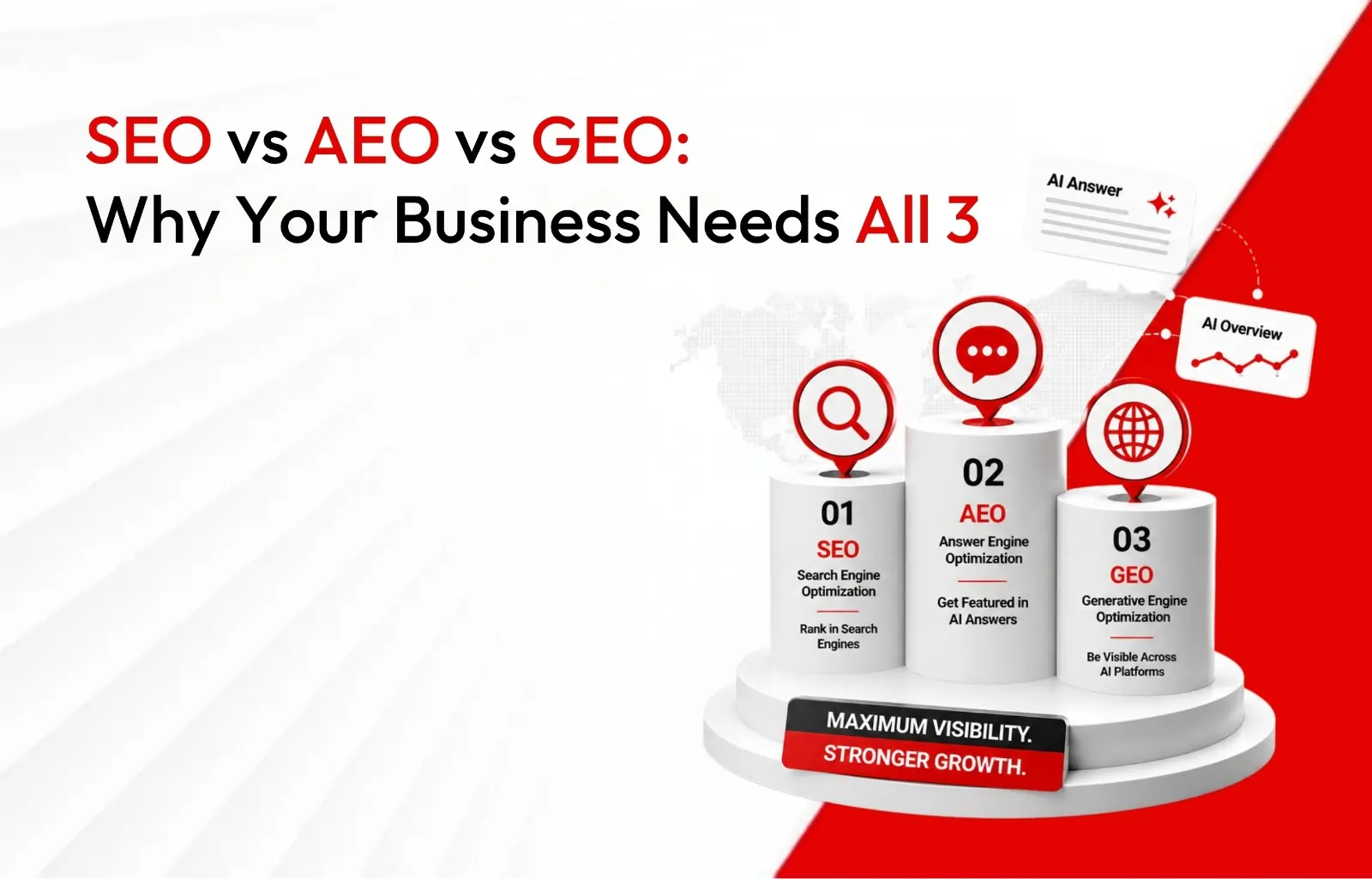
Although these three strategies often overlap, they serve different purposes.
SEO focuses on helping your website rank higher in traditional search engine results. It revolves around keywords, technical optimization, backlinks, and user experience to attract organic traffic.
AEO, on the other hand, aims to help your content become the direct answer users receive from search engines and voice assistants. It prioritizes question-based content, concise explanations, and structured formatting.
GEO takes things one step further by optimizing content for generative AI platforms. Instead of merely helping users find your website or answer their questions, GEO increases the likelihood that AI tools will understand, trust, and reference your content while generating responses.
A simple way to remember the difference is this:
SEO helps people find you, AEO helps people understand you, and GEO helps AI recommend you.
Together, these three approaches cover the entire modern search ecosystem.
Many organizations still invest exclusively in SEO because it has been the industry standard for years. While SEO remains essential, relying on it alone is like preparing for yesterday's internet instead of tomorrows.
Modern consumers search across multiple platforms before making decisions. They compare AI-generated recommendations, ask follow-up questions, and seek trustworthy answers without necessarily visiting numerous websites.
Businesses that embrace SEO, AEO, and GEO together enjoy broader visibility across search engines, answer engines, and AI platforms. Their content reaches users regardless of where the search begins. More importantly, they position themselves as reliable sources of information rather than simply another website competing for clicks.
This integrated approach also creates a better user experience. SEO brings visitors to your website, AEO helps them quickly find the information they need, and GEO ensures your expertise extends beyond your website into AI-generated conversations.
The good news is that you don't need three separate strategies to make your business visible across today's search landscape. The key is to create valuable, user-focused content that naturally supports SEO, AEO, and GEO together. Start by understanding your audience's search intent and answering their questions with clear, informative, and engaging content.
At the same time, ensure your website is easy for both users and AI systems to understand. A well-organized site with quality content, relevant internal linking, helpful FAQs, and an AI-ready structure makes it easier for search engines and generative AI platforms to discover, interpret, and recommend your content.
Finally, remember that consistency matters more than chasing every algorithm update. Regularly updating your content, building topical authority, and publishing trustworthy information will strengthen your online presence over time. When SEO, AEO, and GEO work together, your business is better equipped to reach customers wherever they choose to search.
The digital world has always evolved, and search is no exception. The rise of artificial intelligence isn't replacing SEO; it is expanding the definition of what it means to be discoverable online.
Whether you're an established and growing digital marketing company in Pune, businesses that continue producing valuable, user-focused content while optimizing for search engines, answer engines, and AI platforms will be better positioned to build trust, authority, and long-term visibility.
The question is no longer whether your website ranks on Google.
The real question is whether your business appears wherever your audience is searching; whether that's Google, an AI assistant, or the next generation of search technology.
Because in today's digital landscape, visibility isn't about choosing between SEO, AEO, or GEO. It's about making sure your business speaks the language of all three.
This placement keeps both keywords natural, maintains readability, and supports SEO without appearing forced.
 Contact Us


