


SEO The Business Optimizer
Search Engine Optimization (SEO) refers to the method used to increase a website ranking on search engine results pages...
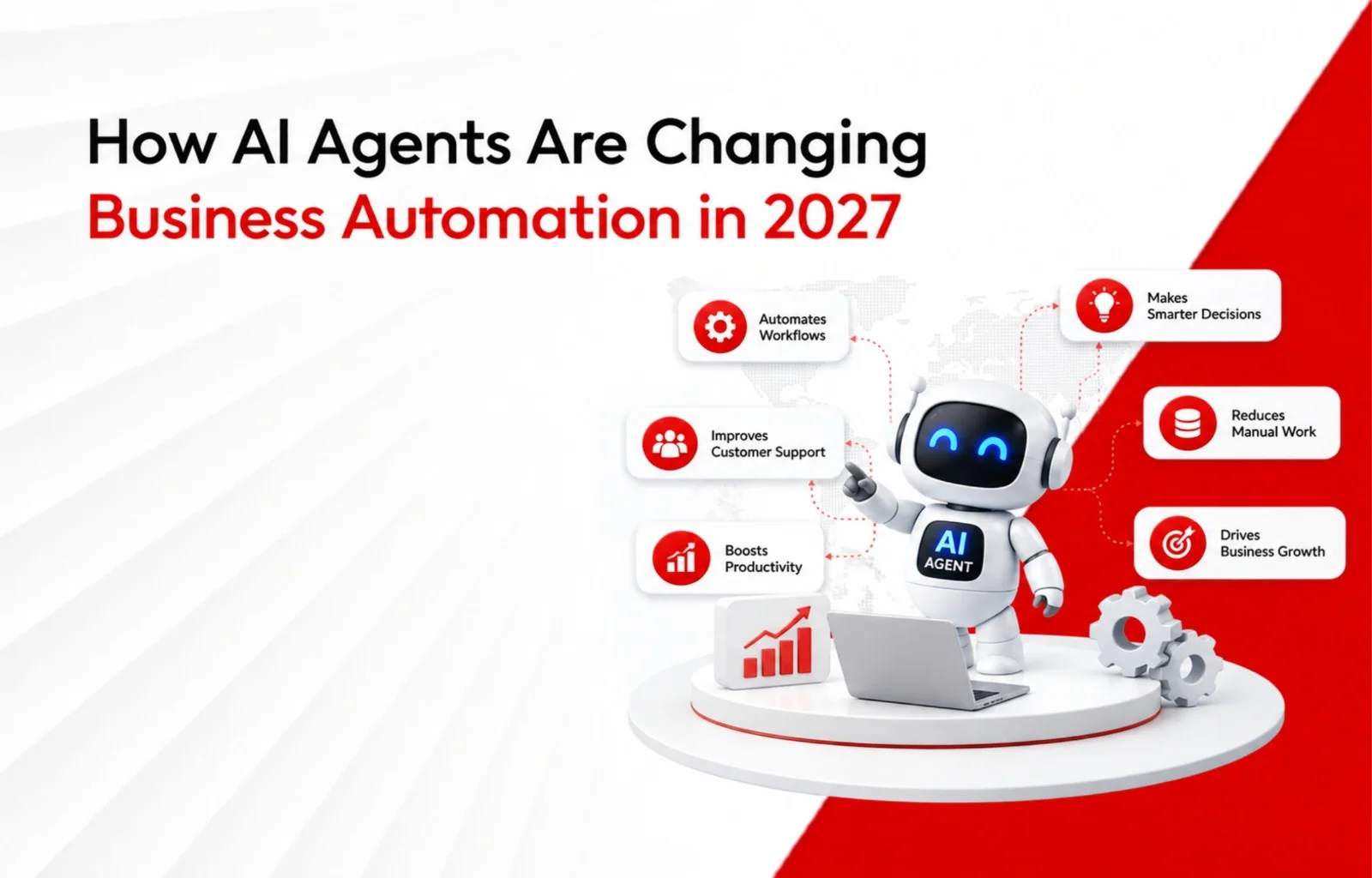
Imagine a workplace where customer queries are resolved before they become complaints, sales leads are followed up without repeated reminders, and reports are ready before the morning meeting begins. No endless email chains. No repetitive manual tasks. No waiting for someone to connect the dots.
Sounds like a glimpse into the future? Welcome to 2027, where artificial intelligence is moving beyond answering questions to taking action.
For years, businesses have used automation to save time and simplify everyday operations. But traditional automation has its limits. It follows predefined rules, depends on structured workflows, and often needs human intervention when something unexpected happens. AI agents are changing that equation. They can interpret information, make decisions within defined boundaries, use digital tools, and execute multi-step tasks with limited human supervision.
The result is a new approach to business automation, one that focuses not just on completing tasks faster but also on making entire processes smarter.
As organisations look for better ways to improve productivity, customer experience, and operational efficiency, AI agents are becoming an important part of the conversation. Here is how they are reshaping business automation in 2027.
Traditional automation is excellent at handling repetitive tasks. If a customer fills out a form, a workflow can send an email. If an invoice arrives, a system can route it for approval. However, when a situation falls outside the predefined rules, the process may stop and wait for human intervention.
AI agents introduce a more flexible approach.
Instead of simply following a fixed sequence of instructions, an AI agent can interpret a goal, evaluate available information, select appropriate tools, and work through a series of steps to achieve an outcome. Depending on its permissions and capabilities, it can also adjust its approach when circumstances change.
Consider a simple example. A business receives a customer enquiry about a delayed order. A traditional workflow might send an automated acknowledgement. An AI agent could go further by checking order information, reviewing delivery updates, identifying the likely issue, and preparing a personalised response. If a refund or other sensitive action requires approval, the agent can escalate the case to a human employee.
This shift from task automation to goal-oriented execution is significant.
Businesses can begin connecting activities that were previously handled across separate systems and departments. Rather than automating individual actions in isolation, they can build workflows that support broader business objectives.
The key difference is not that AI agents can do everything independently. It is that they can handle more of the reasoning and coordination required to move a process forward.
Customers expect quick, relevant, and consistent support. They do not want to repeat the same information to multiple representatives or wait hours for answers to routine questions.
AI agents are helping businesses move towards more responsive customer experiences.
Unlike basic chatbots that rely heavily on predefined responses, AI-powered agents can interpret natural language, use relevant customer context, and connect with business systems to provide more useful assistance. Depending on the implementation, they can help customers track orders, understand product options, troubleshoot common problems, update account information, and navigate service requests.
Imagine an online shopper asking whether a product will arrive before the weekend. An AI agent could check the product's availability, review delivery estimates, and explain the available options. If the delivery date cannot be guaranteed, it can communicate that limitation rather than offering a misleading promise.
The benefits extend beyond customer support. AI agents can assist sales teams by qualifying incoming leads, answering preliminary product questions, scheduling demonstrations, and recording interactions in a customer relationship management system.
For marketing teams, they can help analyse campaign performance, organise customer feedback, and prepare audience insights for review.
However, personalisation must come with responsibility. Businesses need to protect customer information, maintain accurate records, and ensure that customers can reach a human representative when necessary.
When implemented thoughtfully, AI agents can make customer interactions more relevant without making them feel impersonal. The goal is not to remove the human touch. It is to make that touch available where it matters most.
Behind every smooth customer experience is a network of internal processes. Procurement, finance, human resources, inventory management, and reporting all involve activities that consume time and depend on accurate information.
AI agents are creating opportunities to improve these processes by coordinating work across different tools and systems.
Take invoice processing as an example. A conventional automated system may extract invoice details and route documents according to predefined rules. An AI agent can potentially compare invoice information with purchase orders, identify discrepancies, gather supporting records, and flag unusual transactions for review.
In finance, agents can assist with expense categorisation, reconciliation support, and the preparation of financial summaries. In human resources, they can answer routine employee questions, organise onboarding tasks, and help track documentation. In supply chain operations, they can monitor inventory information, identify potential shortages, and recommend replenishment actions based on defined business rules.
These capabilities can help reduce administrative workloads and give employees more time for activities that require judgement, collaboration, and strategic thinking.
The real opportunity lies in connecting these improvements.
When AI agents can coordinate tasks across multiple systems, a process that once involved several handovers may become more streamlined. A purchasing request, for instance, could trigger checks on inventory, budget availability, and approval requirements before reaching the appropriate decision-maker.
Still, automation should not mean automatic approval of everything. Financial commitments, compliance-sensitive activities, and decisions with significant business consequences need suitable controls.
The most effective approach combines AI-driven coordination with clear approval rules, audit trails, and human oversight.
One of the biggest misconceptions about AI agents is that their purpose is to replace people entirely. In practice, their more immediate value often comes from helping people work more effectively.
As AI agents take on repetitive research, data gathering, drafting, monitoring, and coordination, employees can devote more attention to problem-solving, relationship building, creative thinking, and decision-making.
Think of a sales manager preparing for a client meeting. Instead of manually gathering information from multiple platforms, the manager could use an AI agent to compile account history, summarise previous conversations, identify outstanding requests, and prepare a meeting brief. The manager remains responsible for the relationship and the final strategy, but spends less time on preparation.
Similarly, a marketing professional could use an agent to review campaign data, identify performance patterns, and suggest areas for further investigation. The professional can then assess the findings, apply brand knowledge, and decide which actions make sense.
This model requires a change in how businesses think about productivity. Success is not simply about how many tasks AI completes. It is about whether teams achieve better outcomes with less unnecessary effort.
It also creates new responsibilities. Employees may need to learn how to supervise AI-generated work, evaluate outputs, manage automated workflows, and recognise when an agent should not act independently.
Businesses that invest in employee training alongside technology adoption are better positioned to make automation useful in everyday work.
Ultimately, the future workplace is likely to depend on collaboration between people, AI agents, and conventional software, with each handling the tasks it is best suited for.
The possibilities are exciting, but adopting AI agents without a clear strategy can introduce new risks. More autonomy does not automatically mean better performance.
Businesses should begin by identifying processes where automation can deliver measurable value. Repetitive, time-consuming workflows with clear objectives are often sensible starting points. Examples include internal support requests, document processing, lead qualification, and routine reporting.
Once a suitable process is identified, organisations need to establish clear boundaries around what an agent can access and do. Permissions should follow the principle of least privilege, giving agents only the access necessary for their assigned responsibilities. High-impact actions should require appropriate human approval.
Data quality is equally important. An agent working with incomplete, outdated, or inconsistent information can make poor recommendations or take the wrong action. Reliable data, well-defined workflows, and integration with existing systems are essential foundations.
Businesses must also consider security, privacy, regulatory requirements, and accountability. Every important automated action should be traceable, and teams should have a way to review decisions, detect errors, and intervene when something goes wrong.
Finally, organisations need to measure results. Time saved, error rates, resolution speed, customer satisfaction, operating costs, and employee productivity can help determine whether an implementation is delivering genuine value.
The smartest strategy is to start small, evaluate performance, improve the workflow, and scale only when the results justify it.
AI agents are changing the meaning of automation. What once focused on executing individual tasks is evolving towards systems that can interpret goals, coordinate workflows, and support decisions across business functions.
In 2027, the opportunity is not simply to automate more work. It is to rethink how work gets done.
Businesses that approach AI agents strategically can reduce operational friction, improve customer experiences, and help employees focus on higher-value responsibilities. Those that rush into adoption without proper controls may find themselves automating inefficiencies rather than solving them.
The difference will come down to implementation, not just innovation.
The question for businesses is no longer whether AI can perform useful tasks. It is where intelligent automation can create meaningful value, how much autonomy it should have, and how people can remain firmly in control.
Because the next big leap in business productivity will not come from technology working alone. It will come from businesses learning how to make intelligence, automation, and human expertise work together.
 Contact Us


